

Why combine solar, a battery, and an EV charger?
They can work well together when the system is designed around the household's actual energy use.
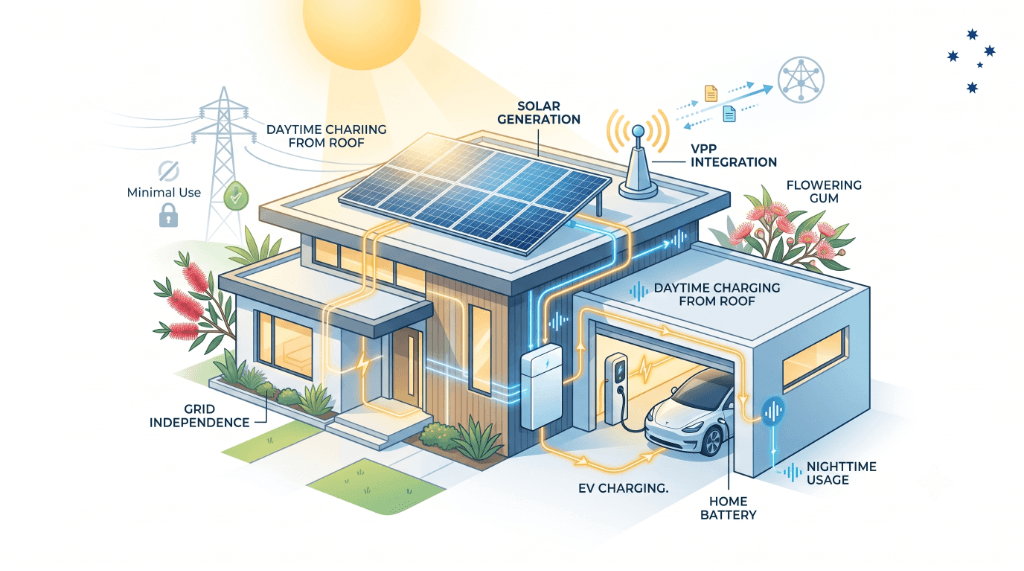
On their own, each of the three technologies delivers a partial benefit. Solar panels cut your daytime electricity bill. A home battery lets you use that solar energy at night. An EV charger replaces petrol costs with electricity costs. When integrated thoughtfully, the system can charge your car on energy your roof generated rather than energy purchased from the grid.
Some compatible home battery systems may also be eligible to participate in a Virtual Power Plant (VPP), depending on the battery, provider and program.
How the energy can be managed
Solar can power the home, charge the battery or charge the EV. What gets priority depends on the equipment, electricity plan, available solar and the settings chosen by the household. For example:
- Some households fill the home battery first.
- Some send daytime surplus directly to the EV.
- Some preserve battery energy for evening loads or backup.
- Some use low-cost grid energy at certain times.
Use more solar directly
Maximise self-consumption when the sun is shining
Store surplus for later
Save energy for the evening or when solar generation drops
Shift EV charging to the best time
Coordinate charging with off-peak rates or peak solar periods
Sizing your system
Planning solar, battery, and EV charging capacity using your actual energy data.
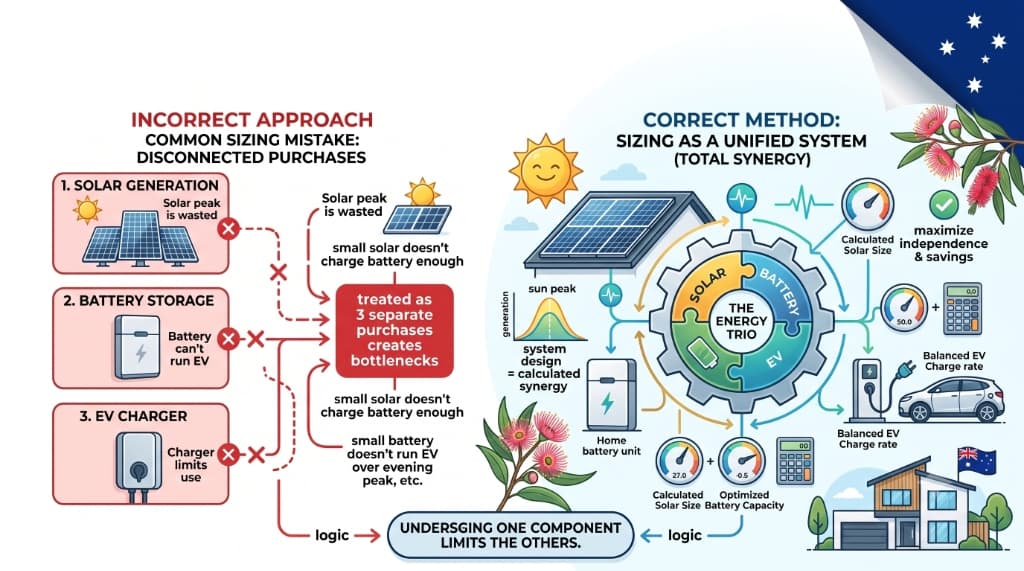
A common planning mistake is treating solar, battery and EV charger as three separate purchasing decisions. They work best when they are planned as parts of the same home energy system, as undersizing any component limits the others.
Step 1: Start with your actual household energy use
Use recent electricity bills or preferably 12 months of interval and smart-meter data to understand your current household use and any future electrification loads.
Step 2: Estimate the EV's normal daily energy requirement
Calculate the energy needed using your daily kilometres and the vehicle's consumption. For example, 50 km/day × 18 kWh/100 km ≈ 9 kWh/day. The energy taken from the wall will be somewhat higher because charging is not 100% efficient.
Step 3: Consider when the EV is home
This is critical. If the EV is home during solar hours, direct solar charging may reduce stationary battery demand. If it is away all day, your battery and electricity tariff strategy become more important.
Step 4: Size solar and battery around the actual load profile
Consider your electricity use and timing, roof area, shading, climate and location, tariff, feed-in tariff, EV charging schedule, backup goals, budget and local network limits. Use actual data and have the solar designer or installer model the system. The Australian Government-supported SunSPOT calculator is a useful independent tool for estimating system sizes and costs.
Check your phase supply
Larger solar, battery and EV charging systems can be affected by your home's phase supply and local electricity-network connection limits. Have the installer check the property's supply and DNSP requirements before finalising the system design. See our 7kW vs 22kW single-phase guide for more details on phase limits.
Smart EV chargers vs standard chargers
Why a solar-aware charger matters when a home battery is in the picture.
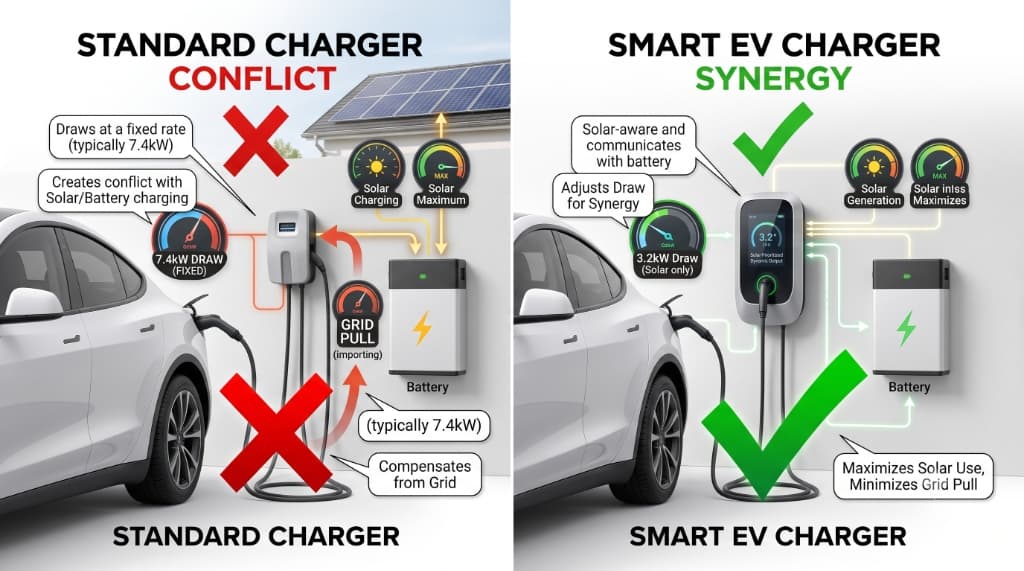
A basic charger may not respond to solar surplus or household load in the same way as a solar-aware charger. Its actual charging power still depends on the charger configuration, vehicle and electrical installation.
A solar-aware or smart charger measures or receives information about household import, export or available solar surplus, then adjusts charging according to the product's capabilities and settings. It can modulate its output. For example, it can reduce power when solar generation drops and ramp back up when surplus is available. It can also defer charging entirely until a scheduled off-peak window.
What to look for in a charger
- OCPP support — can improve interoperability with compatible charging-management platforms. Available features depend on the charger's OCPP version and the platform.
- Solar surplus charging — automatically uses excess solar rather than drawing from the grid.
- Battery prioritisation — some systems allow you to prioritise the home battery, EV or other loads. The available controls depend on the charger, battery, inverter and energy management setup.
- Dynamic load management — can reduce EV charging power when household demand is high, helping keep charging within the configured site or supply limit.
See our Best Solar EV Chargers Australia guide for a comparison of solar-aware charger models available in Australia.
Cost breakdown and ROI
Understanding what affects the system price and how to approach payback.
What affects the cost?
The total cost of an integrated system varies significantly. Key factors include:
- Solar system size and battery usable capacity
- Inverter architecture and the specific EV charger model
- Roof and site access
- Switchboard upgrades and cable runs
- Trenching, metering and supply or network changes
- Installer fees and available government rebates
Use appropriately licensed and accredited installers (such as Solar Accreditation Australia-accredited professionals), and check that eligible battery and inverter products meet the requirements of the relevant government incentive. Always obtain multiple written quotes.
Payback estimate
Payback depends on the system cost, electricity use, when energy is used, tariff, solar production, battery cycling, EV charging behaviour and available incentives.
Use a household-specific model such as SunSPOT or an installer proposal that clearly shows its assumptions. The Australian Government's Cheaper Home Batteries Program provides an upfront discount on eligible battery systems through STCs, with the value depending on factors including usable battery capacity and installation date. See our Rebates guide for more details.
Could bidirectional charging change your battery plans?
Some EVs and charging systems can support bidirectional energy use, including vehicle-to-home (V2H). This could give some households another source of stored energy, but Australian compatibility is still developing.
V2H cross-reference
V2H depends on the vehicle, charging equipment, electrical installation, software and local electricity-network requirements. If bidirectional charging matters to your plans, check current Australian compatibility before deciding on a stationary battery. Learn more in our Bidirectional Charging Guide →
Common mistakes when planning
The planning errors that are easy to avoid once you know what to look for.
Mistake 1: Assuming your existing solar will cover the EV
Adding an EV changes the household load profile. Check how much energy the vehicle actually needs and when it will normally charge before deciding whether the existing solar system is large enough.
Mistake 2: Assuming any charger works with any battery
Some chargers and batteries have native integration, while others coordinate through meters, sensors or compatible third-party platforms. Check the exact product compatibility before buying equipment based on an assumed integration.
Mistake 3: Ignoring the inverter bottleneck
Battery capacity (kWh) and battery or inverter output (kW) are different. Check the system's continuous output and how it will interact with household loads and EV charging. Grid energy may supplement loads depending on the design and settings.
Mistake 4: Treating the battery as an EV charger
A home battery can contribute to EV charging, but how much depends on its usable capacity and discharge power. A typical household battery usually holds much less energy than an EV battery, so it is better considered part of the whole home-energy strategy rather than a dedicated EV fuel tank. See our detailed breakdown in the Battery and EV Charging guide.
Mistake 5: Assuming the battery provides blackout backup
Some battery systems can provide backup power during an outage when designed and configured to do so. It requires specific hardware and wiring. Do not assume the whole home is backed up or that EV charging will continue during an outage.
Frequently asked questions
Common questions about integrating solar, battery, and EV charging in one system.
Find the right charger for your solar + battery setup
Tell us about your EV, home and charging needs.