

Can a home battery actually charge an EV?
The short answer is yes — with significant caveats about how much it can contribute.
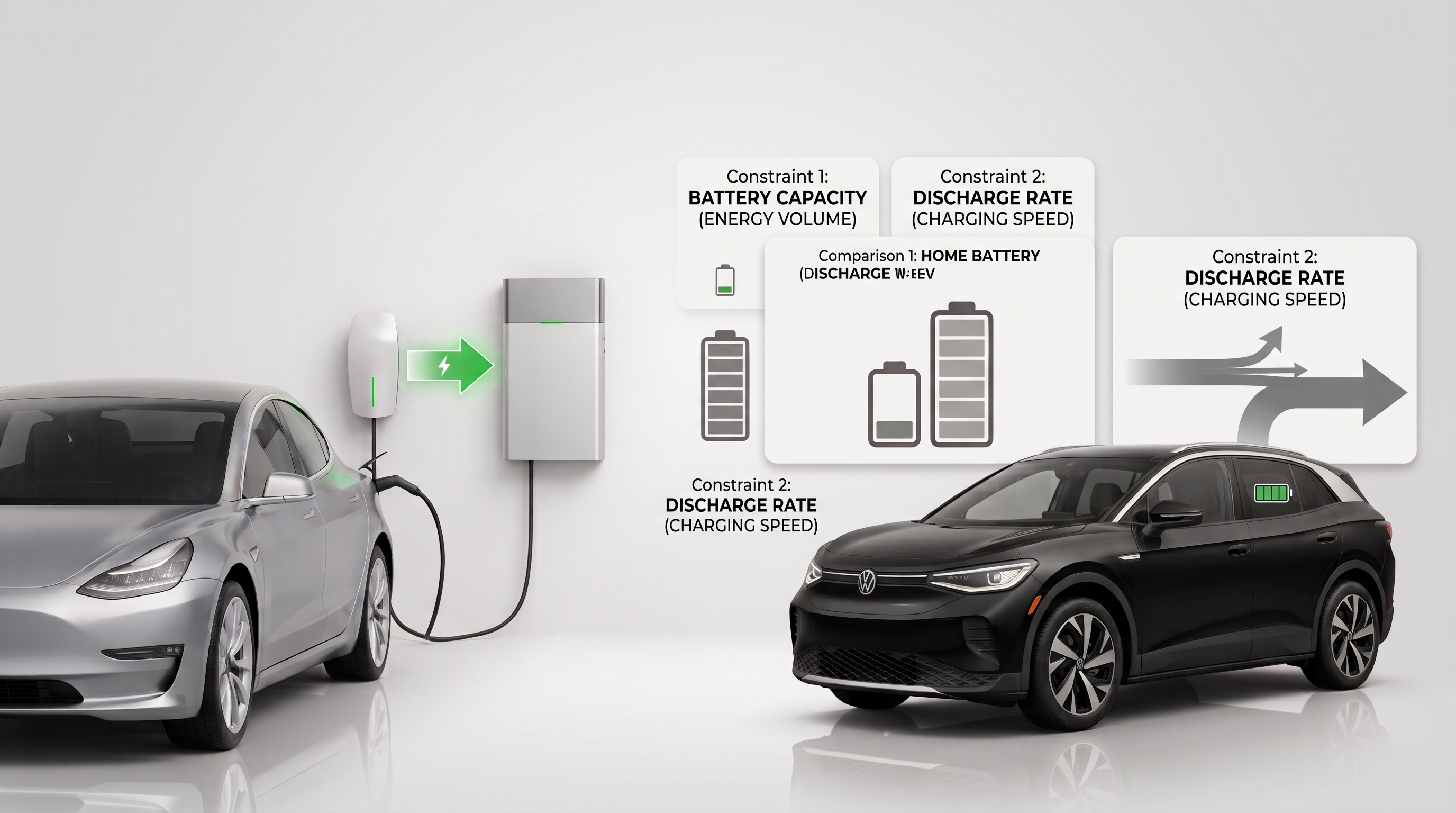
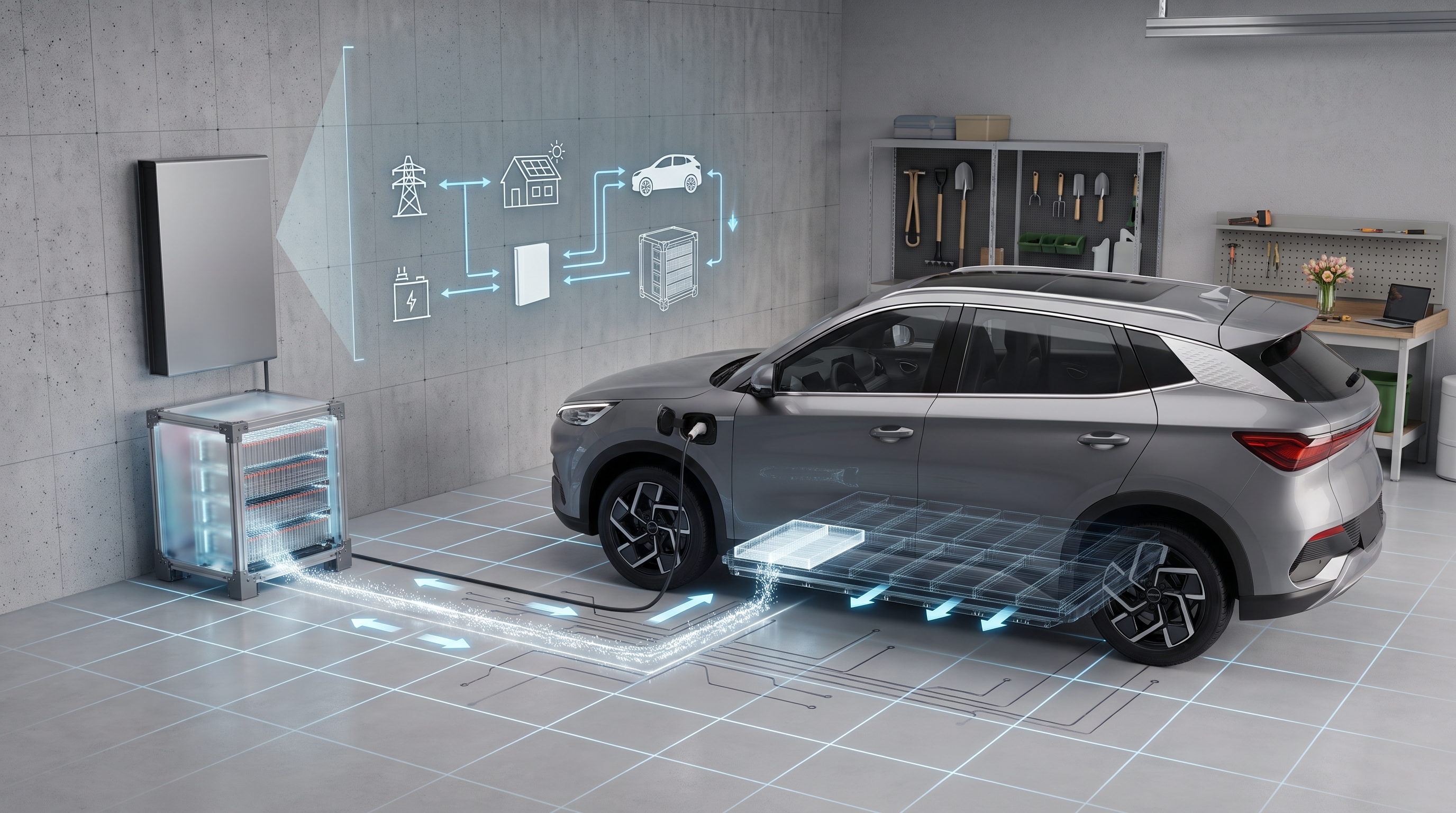
In many home energy systems, a home battery can contribute to EV charging as part of the home's electrical load. How much it contributes depends on the battery and inverter output, battery state of charge and reserve settings, household loads, system controls and the home's electrical setup.
The practical limits come down to two things: battery capacity (how much total energy is stored) and discharge rate (how fast the battery can release it). Both constrain how useful a home battery actually is for EV charging.
The key insight
A home battery is best understood as a tool for load-shifting household energy (e.g. using stored solar to power your lights, appliances, and TV in the evening) — not as a direct EV charging source. It can contribute to EV charging, but it cannot replace a grid connection or daytime solar access for topping up a large EV battery.
The capacity problem: home batteries vs EV batteries
The numbers explain why a home battery can top up your EV, but cannot fill it.
A 13.5 kWh home battery stores much less energy than a typical EV battery. For example, compared with the 60.48 kWh battery listed for the BYD ATTO 3 Extended Range, 13.5 kWh is about 22% of the listed battery capacity before allowing for battery reserve, household use or conversion losses.
Some energy is lost through battery, inverter and vehicle charging processes, so not all of the energy stored in the home battery reaches the EV battery.
13.5 kWh
Tesla Powerwall 3 usable capacity (AU)
60.48 kWh
BYD Atto 3 battery (from vehicles database)
~22%
Max EV fill from one Powerwall 3
Discharge rates: how fast can a battery charge your EV?
It's not just about how much energy is stored: it's about how quickly the battery can deliver it.
Battery capacity and battery power are different. Capacity, measured in kWh, tells you how much energy the battery can store. Power, measured in kW, tells you how much electrical load the battery and inverter can support at a given time.
Powerwall 3 output depends on the system configuration and local installation requirements, so its maximum quoted power should not be treated as the available output for every Australian installation.
Your home's electrical setup still matters. An EV charger is a significant household load, so a licensed electrician should check the available supply, switchboard, maximum demand, phase configuration, other large loads and any battery or load-management controls. Depending on the property and local network requirements, a connection change or network approval may also be required.
A battery's power rating alone does not determine how it can support EV charging. The result also depends on the home's phase configuration, charger setup, vehicle AC charging limit, household loads, battery controls and available electrical supply.
What this means at home
As an idealised example, 13.5 kWh divided by 7.4 kW is about 1.8 hours. Real-world battery contribution will be lower or shorter if some stored energy is reserved, other household loads are running, or energy is lost through conversion and charging.
When does charging from a battery actually make sense?
The scenarios where a home battery genuinely improves your EV charging situation.
Whether a home battery can meaningfully contribute to your EV charging depends on how much energy the EV needs each day, how much battery energy is available after household use and reserve settings, when the car is at home, solar generation and your electricity plan.
A practical charging approach
The most economical charging time depends on your electricity plan, solar generation and household energy use. For some homes that may mean charging overnight. For others, daytime solar or a cheap or free daytime electricity window may make more sense.
Stationary home battery vs V2H technology
An EV battery usually stores much more energy than a typical home battery.
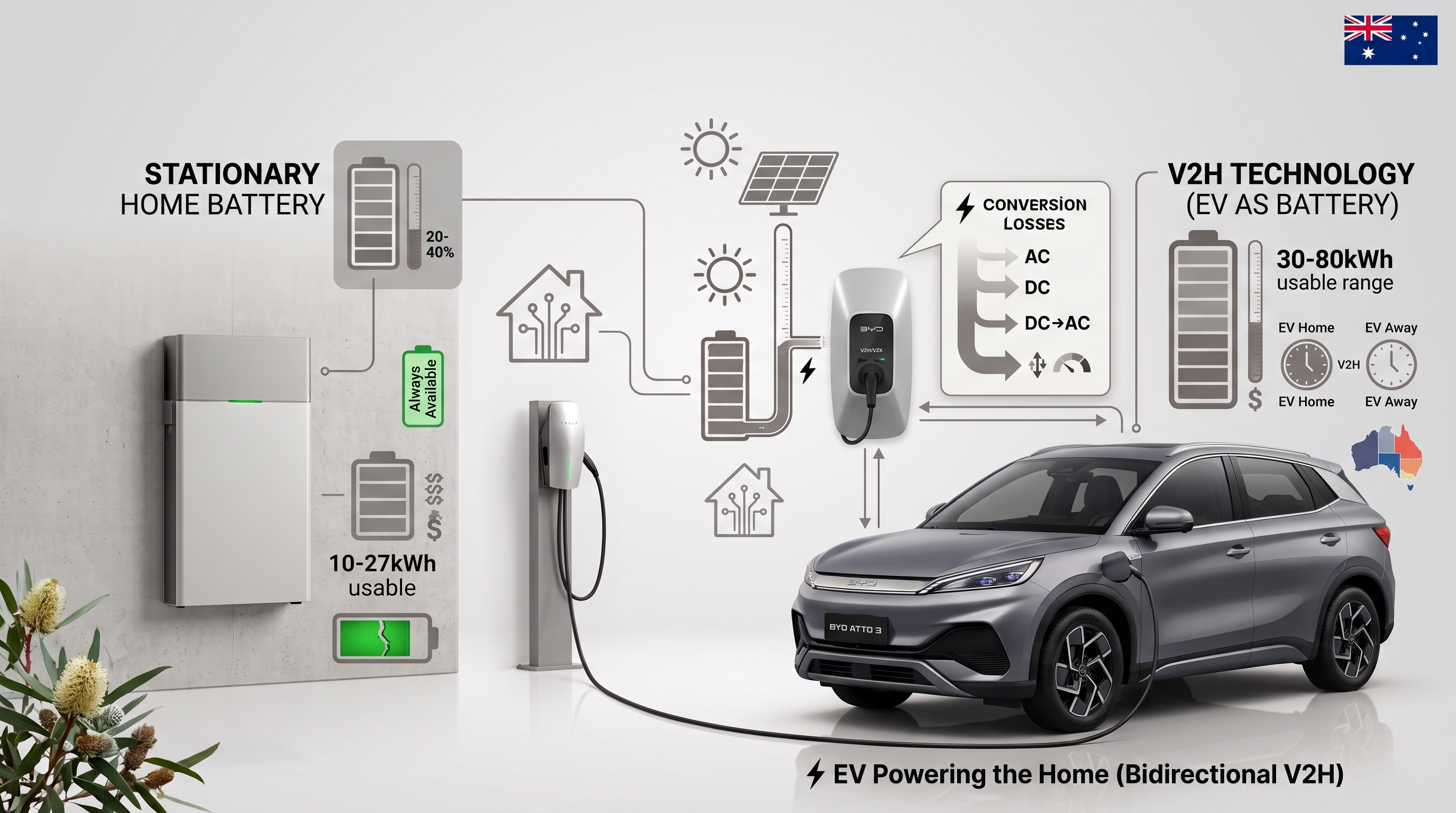
Vehicle-to-home, or V2H, allows a compatible EV and bidirectional charging system to supply electricity from the vehicle battery back to the home. Australian support is still developing, and compatibility depends on the vehicle, bidirectional charger, software, electrical installation and local electricity-network requirements.
V2H in Australia
Frequently asked questions
Common questions about using a home battery alongside EV charging.