
Understanding Australian battery incentives
How the rebate landscape is structured, and why dollar figures in this guide are indicative only.
Important: rebate amounts change frequently
Battery rebate programs open, close, pause, and change their eligibility criteria regularly. Dollar figures in this guide reflect the position as of mid-2026 and are provided for context only. Always verify current amounts and eligibility directly with the official program administrator using the government links provided in each section below.
Australian home battery incentives come from three distinct sources, and understanding the difference matters when planning your purchase:
- 1Federal programs: Federal support: the Cheaper Home Batteries Program operates through the Small-scale Renewable Energy Scheme (SRES). Eligible systems create small-scale technology certificates (STCs), which can be assigned to a registered agent for an upfront discount.
- 2State and territory schemes: State and territory schemes vary by jurisdiction. Some offer rebates, subsidised loans or other support subject to their own eligibility rules.
- 3Virtual Power Plant (VPP) incentives: VPP incentives can come from government schemes, electricity retailers or VPP providers. Payments, eligibility and control arrangements vary by program.
Federal vs state rebates
Why batteries are treated differently from solar panels at the federal level, and where state programs fill the gap.
The Australian Government's Cheaper Home Batteries Program commenced on 1 July 2025. It supports eligible battery systems connected to new or existing solar PV through small-scale technology certificates under the Small-scale Renewable Energy Scheme. The Australian Government describes the support as around 30% of the upfront installation cost for a range of eligible systems.
From 1 May 2026, the STC calculation changed. For installations from May to December 2026, the STC factor is 6.8. The factor applies at 100% for the first 14 kWh of usable capacity, 60% for the portion above 14 to 28 kWh, and 15% for the portion above 28 to 50 kWh.
Eligible battery systems must have a nominal capacity between 5 and 100 kWh. STCs are provided only for the first 50 kWh of usable capacity.
An upfront discount can be provided when you assign your right to create STCs to a registered agent. You can also choose to create and sell the STCs yourself.
Always verify the current program status, funding availability, and eligibility criteria at the official national program page: energy.gov.au: Cheaper Home Batteries Program . For a broader view of national incentives, visit the government's general solar directory at energy.gov.au: rebates and loans .
Product and installer eligibility
For the federal Cheaper Home Batteries Program, the battery must be on the Clean Energy Council approved battery list and the installation must be completed by a Solar Accreditation Australia-accredited installer with the appropriate battery accreditation. The installation must also comply with applicable Australian standards, state or territory electrical-safety laws and SAA technical requirements.
The Clean Energy Council approved-product lists can change, so check the battery's current listing before installation.
For a grid-connected system to qualify under the federal program, the battery must be technically capable of participating in a virtual power plant. You do not have to join a VPP to receive the federal discount.
Rebate eligibility does not replace electrical-safety or electricity-network requirements. Depending on the system and local DNSP, a grid-connected battery may also require a connection application, approval or registration. Your installer should confirm the requirements before installation.
State-by-state battery rebates
What each state and territory offers, with links to official sources for current amounts.
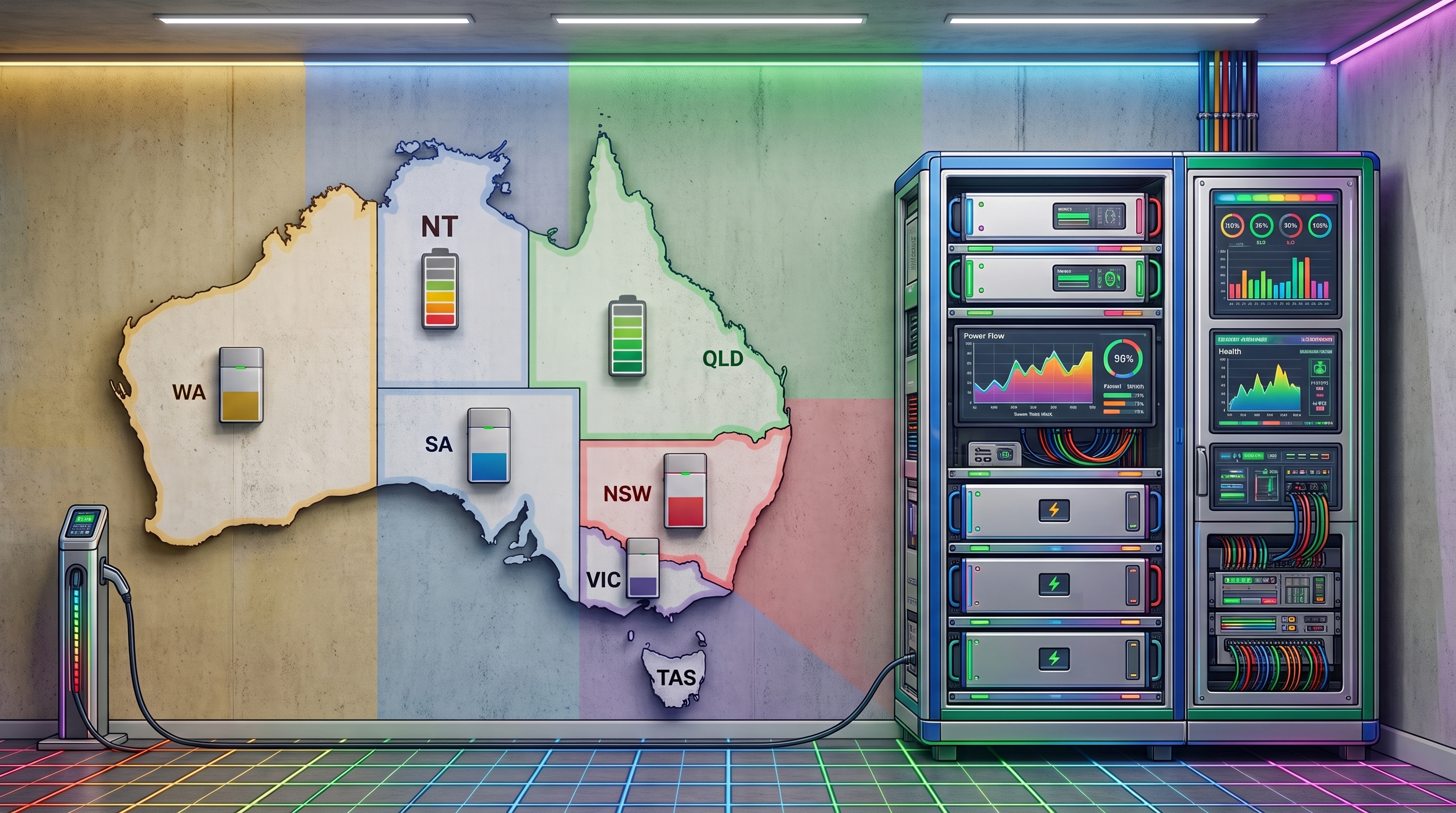
Victoria (VIC)
The Solar Victoria battery loan program is closed to new applications.
Official source: solar.vic.gov.au: Solar Battery Loan (Closed)New South Wales (NSW)
The former NSW household battery installation discount is no longer available. The NSW Government VPP incentive remains available for eligible batteries. From 1 July 2026, eligible battery capacity for the VPP incentive is 2 to 50 kWh. A battery installed under the Australian Government's Cheaper Home Batteries Program may also qualify for the NSW VPP incentive if the NSW eligibility requirements are met.
Official source: energy.nsw.gov.au: Batteries & VPP IncentivesQueensland (QLD)
The Queensland Battery Booster program is closed. Rebates are no longer available under that program.
Official source: epw.qld.gov.au: Battery Booster (Closed)South Australia (SA)
The SA Home Battery Scheme is closed to new applications.
Official source: sa.gov.au: Solar & Batteries infoWestern Australia (WA)
The WA Residential Battery Scheme is open. It offers a state rebate and, for eligible households, a no-interest loan. Applicants must join an eligible VPP product to receive the state rebate or loan.
Official source: wa.gov.au: WA Residential Battery SchemeAustralian Capital Territory (ACT)
Under the ACT Sustainable Household Scheme, eligible households can access low-interest loans from $2,000 to $20,000. Household battery storage and EV charging infrastructure are both eligible products. A 3% interest rate applies to standard household loans, subject to the scheme terms.
Official source: climatechoices.act.gov.au: Sustainable Household SchemeNorthern Territory (NT)
The NT Home and Business Battery Scheme has reached its funding cap and is closed to new grants. Check the NT Government website for any future replacement or reopened program.
Official source: nt.gov.au: Home and Business Battery SchemeTasmania (TAS)
Tasmania's Energy Saver Loan Scheme closed on 1 September 2025. Tasmanian households can still check their eligibility for the Australian Government's Cheaper Home Batteries Program.
Official source: energy.gov.au: Cheaper Home Batteries ProgramVIC, NSW, SA
States with most active battery rebate histories
CEC required
Accreditation needed for most rebates
Check often
Programs open and close with funding rounds
Virtual Power Plant (VPP) incentives
How VPP incentives work and what participation can involve.
A Virtual Power Plant coordinates participating batteries so stored energy can be dispatched or exported under the terms of the VPP offer. Payments and control arrangements vary by provider and program.
VPP financial benefits can include upfront incentives, bill credits or payments linked to exports or dispatch events. The structure varies by provider.
To participate, you need a battery and control system supported by the VPP offer, plus any communications and metering required by that program. Check the provider's compatibility requirements and terms before buying equipment.
Under the federal Cheaper Home Batteries Program, a grid-connected battery must be VPP-capable, but VPP participation is not mandatory. By contrast, the WA Residential Battery Scheme requires eligible applicants to join a VPP product.
A practical starting point is your state or territory energy website and the current offers published by participating electricity retailers or VPP providers.
Can battery support be combined with EV charger incentives?
How battery and EV charging support can interact.
There is no single Australian rule for combining battery and EV-charger support. Whether incentives can be combined depends on the terms of each program.
Some schemes can include both battery storage and EV charging infrastructure, while others prohibit overlapping incentives for the same installation or impose combined funding limits.
For example, the ACT Sustainable Household Scheme lists both household battery storage and EV charging infrastructure as eligible products within the scheme's overall loan limit.
Check the current rules of each program before signing a contract or ordering equipment.
Bidirectional charging and battery incentives
V2H and V2G are developing separately from stationary-battery rebate programs. Do not assume a bidirectional charger or EV qualifies for a home-battery incentive.
Compatibility depends on the vehicle, charging equipment, software and local electricity-network requirements. Check current manufacturer documentation before relying on V2H or V2G capability.
For current Australian V2H and V2G information, see our Bidirectional Charging Guide.
Frequently asked questions
Common questions about home battery rebates in Australia.
EV Charger Rebates
Information on rebates and incentives specifically for EV chargers.